
RESPONSIBLE SOURCING
We use a risk-based green-coffee HREDD process to identify and address human-rights and environmental risks, and we support farmers through targeted programmes.
At JDE Peet’s we are passionate about coffee and tea: It’s who we are and all we do.
Responsible Sourcing:
A farmer inclusive approach
Coffee and tea are grown in diverse origins, each with unique farming and production systems. We recognise and appreciate this rich diversity, which is why we have developed a Responsible Sourcing programme that is inclusive of the different origins and the millions of smallholder farmers and workers. This is reflected in both our sourcing strategy and the geographic reach of our Common Grounds Farmer Programme.
At JDE Peet’s we are acting responsibly to ensure every cup contributes to a better future. Sourcing coffee and tea responsibly is more than just meeting a target, it means engaging with farmers and situations in our sourcing regions to better assess the challenges and then actively invest to address these issues and drive progress.
Responsibly sourced does not mean or imply the absence of human rights violations or other supply chain risks in connection with the production or supply of coffee or tea. It is about delivering continuous improvement and measurable progress for people, nature and climate. At JDE Peet's we use a risk-based green-coffee HREDD process to identify and address human-rights and environmental impacts through prevention, mitigation, monitoring, communication and remediation where appropriate.
We define "Responsibly sourced" as green coffee volumes that have completed all required Human Rights and Environmental Due Diligence (HREDD) steps. For tea, it means third party validation. For full methodology and definitions, refer to our 2025 Annual Report.
- In 2025*, 88.8% of green coffee met our responsibly sourced definition, aligned to our green coffee HREDD process.
- We also achieved 100% responsibly sourced green coffee sold into Europe**.
These results do not mean risk or adverse impacts are absent; our HREDD process prioritises and addresses identified impacts.
* In preparation for CSDDD implementation, the methodology changed in 2025, aligning 'responsibly sourced' to our green coffee HREDD. While we fully transition, the ‘% responsibly sourced green coffee Europe’, remains **calculated with the previous methodology due to customers' requirements. For further details on the calculation methodology, please refer to our 2025 Annual Report and Bureau Veritas assurance report.
Assess, Address, Progress
At JDE Peet's, acting responsibly translates into understanding and addressing the challenges to drive continuous progress. We are applying a data-driven, risk-based approach, and actively taking ownership of what we identify to be the most important of all challenges for our business - to help create a better future for coffee and tea.
Thanks to our global scale and focus on coffee and tea, we can invest directly in origins to drive measurable change to protect and build long-term resilience for our business, people and the planet.

We Assess
We apply third-party assessments to map our supply chain and identify focus areas. This assessment is based on a representative sample of all farmers in our sourcing areas, covering critical topics such as child labour, working conditions, climate and nature, as well as engaging our suppliers in self-assessments to determine their responsible business practices and risks and opportunities of farming communities.
We Address
We use the information and insights to invest and address identified gaps by establishing multi-year farmer programmes (3 to 10 years), where we partner with farmers, cooperatives, suppliers, NGOs, and governments to improve practices and increase adoption across the relevant focus areas identified by these assessments.
We Progress
We measure impact of our farmer programmes, sharing and learning from the insights of the interventions. We recognise that many issues are complex and will take multiple years to solve, but it is our responsibility to engage our stakeholders in an open dialogue and invest in collaborative actions to address critical social and environmental issues within coffee and tea sourcing origins.
Common Grounds Farmer Programme
Our Common Grounds Farmer Programme dates back to 2015, where we continue to increase both the scale and reach through investments and partnerships in our key sourcing regions.
We are partnering with farming communities, suppliers, non-governmental organisations, and local government bodies to deliver multi-year projects that address local realities including sustainable and regenerative farming practices (e.g. climate-smart agriculture, crop quality, biodiversity), farmer livelihoods, or labour practices.








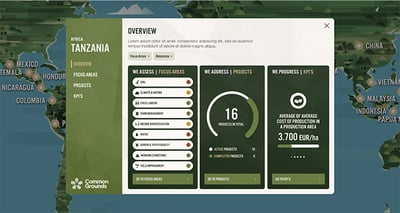
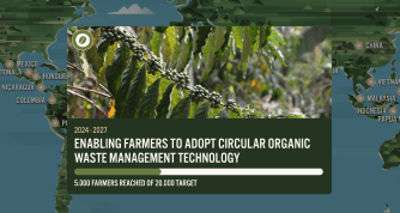
When you click on a country you will see a quick overview of past and active projects as well as which focus areas the projects are working on. You will then be prompted to explore further
In the Overview page, at a country level you will see our “Assess, Address, Progress” approach. If you navigate to “We Assess | Focus Areas” you can find out more on the 9 focus areas of our Responsible Sourcing Programme by clicking on “Go To Focus Areas”, where you will find the level of support needed by farmers and the different ratings over the years
If you navigate to “Projects” you will find an overview of the current projects as well as past projects, and an opportunity to learn more about the project, the main metrics and our partners
Our Responsible Sourcing Principles
Sustainability of Land
Regenerative agriculture and responsible land use practices are critical to address climate change and biodiversity loss.

CLIMATE AND NATURE
Our approach is based on mitigation and adaptation to climate change. Our principles require that biodiversity, natural forests and ecosystems be protected from conversion or degradation, and we monitor supplier adherence.

SOIL
Soil fertility and conservation is maintained and improved through farmer training and appropriate soil testing.

WATER
We support farmers with technology for cost efficient wastewater disposal and help them understand how to manage and save water.
Equality of People
International standards on human rights are upheld for children, farmers and workers.

GENDER & YOUTH EQUALITY
Our partners implement locally relevant and culturally appropriate strategies to increase opportunities for women and young people.

CHILD LABOUR
We are working to get to the root causes of child labour and building sustainable solutions to address this.

WORKING CONDITIONS
We include training on safe working conditions and access to protective equipment for agrochemical application.
Prosperity of Farmers
We help build capacities to make farming more economically viable.

FARM MANAGEMENT
With a strong emphasis on farmer participation, we support farmers to adopt good agricultural practices and we provide business and financial training.

YIELD IMPROVEMENT
Training in applying good agricultural practices helps increase yields, leading to increased incomes and contributes to improved livelihoods.

INCOME DIVERSIFICATION
Supporting farmers to diversify their portfolio of products helps improve efficiency of output on existing land and increase their earning capacities.
In 2025, we sourced 88.8% of our green coffee in line with HREDD and 99.5% of our tea and 100% of our palm oil met our responsible sourcing requirements.